Monday, September 30, 2013

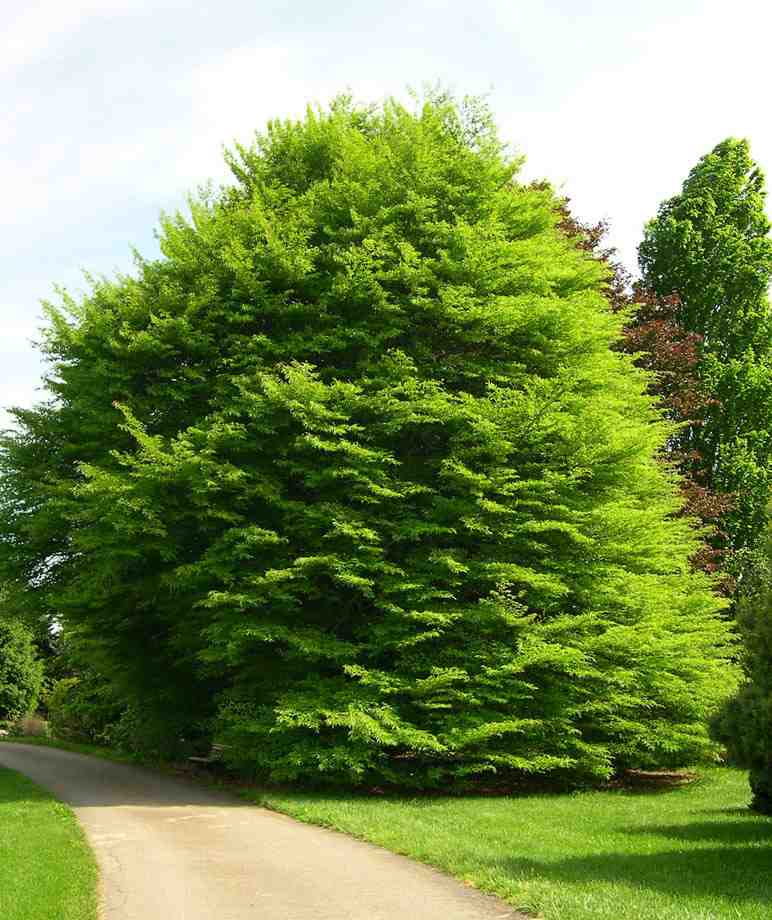
Fagus sylvatica – European Beech


General Information
Common Name European Beech
Scientific Name Fagus sylvatica
Sun Tolerance Full Sun
Height 25–35 m (80–115 ft)
Spread up to 15 m (up to 50 ft)
Growth Rate Moderate 
Bloom Time Spring
Color Green
Flower Color Green
Type Tree
Native Europe, western Asia
Classification
Kingdom Plantae – Plants
Subkingdom Tracheobionta – Vascular plants
SuperdivisionSpermatophyta – Seed plants
Division Magnoliophyta – Flowering plants
Class Magnoliopsida – Dicotyledons
Subclass Hamamelididae
Order Fagales
Family Fagaceae – Beech family
Genus Fagus L. – beech
Species F. sylvatica

Fagus sylvatica – European Beech
European Beech Scientific name is Fagus sylvatica is one of the best known trees in Europe. It is seen particularly on chalk and limestone formations such as the Cotswold’s, Chilterns and Downs. It is graceful tall tree, reaching heights of up to 49 m (160 ft) tall and 3 m (10 ft) trunk diameter, sometimes called 'The Lady of the Woods'. The thick shade which it sheds usually keeps the forest floor bereft of undergrowth. The mature, almost mono-culture beech wood, has a beauty rarely surpassed. It is also a long living tree that has a typical lifespan of 150 to 200 years, though sometimes up to 300 years.
The new shoots, grey and transparent, develop into long, thin, zigzag twigs which hold pale brown winter buds, set alternately and long and slender, with papery scales, 5–10 cm long and 3–7 cm broad, with 6-7 veins on each side of the leaf . The leaves are a tender pale green when opening in April, later becoming a rich deep green shade. They are oval, end in a short point and have a wavy margin which with the veins on the underside and the leaf-stalks are at first hairy. In autumn the leaves change to glorious tints of bronze, orange and gold. Trees below a height of about 10 ft retain their spent red-brown leaves throughout winter, but larger trees strew them over the forest floor until they are swept by the wind to lie in deep drifts.
The male catkins are borne in groups of two or three soon after the leaves open, each catkin has a long thin drooping stalk which bears two or three slender scale leaves and ends in a tassel of about fifteen greenish flowers. The female catkins are small, green, and lie close to the stem. At first the fruit is an egg-shaped pointed green husk, clad in soft green hairs. In the autumn the husks turn brown, and after splitting into four lobes to release one or two triangular, smooth shining brown seeds (‘beech nuts’), they often persist on the tree until the following spring. Good ‘mast years’ occur infrequently. The nuts provide, with acorns, pannage for pigs.
Fagus sylvatica – European Beech
The thin bark is of a typical bright silver-grey or metallic color and remains smooth throughout the tree’s life. In some parts of the country the naked circular columnar trunks have in part almost a purplish sheen. In outline Beech is large, upright, with a crown comprising a spreading network of fine branches. Its base is almost always but-tressed. The wood is hard and strong, of a bright buff color with mid-brown flecks (‘pith rays’). Among its chief uses are furniture and turnery goods such as tool handles, bowls and spoons.
Beech freely regenerates from fallen seed. It is usually planted pure or as groups in a matrix of other trees or as an underpants. It has a high amenity value.

Beeches with coppery red or deep purple foliage are frequently seen. The Copper Beech, variety purpurea (altropunicea), is a natural ‘spot’ Discovered in the eighteenth century. The rich purplish-brown color of its leaves masks their green chlorophyll within but they function normally. The tree is usually grafted onto stock of the common Beech but will also grow from seed.


Fagus sylvatica – European Beech : Leaves

Fagus sylvatica – European Beech : Leaves

Fagus sylvatica – European Beech : Leaves

Fagus sylvatica – European Beech : Flowers

Fagus sylvatica – European Beech : Flowers

Fagus sylvatica – European Beech : Nut

Fagus sylvatica – European Beech : Nuts

Fagus sylvatica – European Beech : Nuts

Fagus sylvatica – European Beech

Fagus sylvatica – European Beech

Fagus sylvatica – European Beech

Fagus sylvatica – European Beech

Fagus sylvatica – European Beech

Fagus sylvatica – European Beech

Fagus sylvatica – European Beech

Wednesday, September 25, 2013

Euonymus europaeus - European Spindle Tree


General Information
Common Name Spindle Tree
Scientific Name Euonymus europaeus
Sun Tolerance Full Sun
Height  2.5-3 m (8-10 ft)
Spread 2.5-3 m (8-10 ft)
Growth Rate Moderate
Bloom Time late Spring, Early Summer
Color Green
Flower Color Green, Greenish White 
Type Shrub
Native Europe, western Asia
Classification
Kingdom Plantae – Plants
Subkingdom Tracheobionta – Vascular plants
SuperdivisionSpermatophyta – Seed plants
Division Magnoliophyta – Flowering plants
Class Magnoliopsida – Dicotyledons
Subclass Rosidae
Order Celastrales
Family Celastraceae – Bittersweet family
Genus Euonymus L. – spindletree
Species E. europaeus

Euonymus europaeus - European Spindle Tree
Euonymus europaeus commonly known as Spindle Tree is native to Europe and Western Asia. This is small but interesting and appears as a shrubs particularly on the chalk downs and locally on lime-rich soils. It is scarcely noticed before autumn, when the displays of its pretty fuchsia-pink seed-pods are conspicuous, accompanied by a delightful show of leaf color, the green leaves changing to russet-red hues before they fall.
The young twigs are green (in autumn a conspicuous component of an otherwise brown hedgerow) and after the first year are four-angled, later developing pale brown cork ribs along the angles of the square, eventually they grow quite round. The winter buds are in opposite pairs. The leaves very from oval to lance-shaped, with a finely toothed margin and a pointed tip. From a shining blue-mid-green (paler on the under-side) they fade in autumn to yellow, russet and crimson.

Euonymus europaeus - Spindle Tree
The small greenish-white flowers are borne in June in loose cluster in the leaf axils. The trees are often either male or female thought flowers including both sexes do occur on the same tree. The female flower produces a four-lobed seed-pod which is pale green at first, but changes to a vivid pink by October. Within a month or two the seed-pod  splist open to expose the four bright orange pulpy coats ( and aril) which each enclose a hard white seed within a pink seed-coat. The seeds are poisonous.
The bark is smooth, greenish at first, later becoming grey to pale brown. The hardness, smoothness and toughness of the whitish wood led to its early use for the spindles used for spinning wool by hand – explaining the tree’s name. The wood also yields a fine charcoal for artists’ use.
Spindle Tree is unpopular with farmers because it is an alternative host to the bean-fly. 


Euonymus europaeus - European Spindle Tree: Leaves

Euonymus europaeus - European Spindle Tree

Euonymus europaeus - European Spindle Tree : Flowers

Euonymus europaeus - European Spindle Tree

Euonymus europaeus - European Spindle Tree : Flowers


Euonymus europaeus - European Spindle Tree

Euonymus europaeus - European Spindle Tree

Euonymus europaeus - European Spindle Tree

Euonymus europaeus - European Spindle Tree

Euonymus europaeus - European Spindle Tree

Euonymus europaeus - European Spindle Tree

Euonymus europaeus - European Spindle Tree


Euonymus europaeus - European Spindle Tree

Euonymus europaeus - European Spindle Tree