| General Information |
| Common Name | Lombardy Poplar |
| Scientific Name | Populus nigra |
| Sun Tolerance | Full Sun |
| Height | 40-50 m (130-150 ft) |
| Spread | 6 -12 m (20 - 40 ft) |
| Growth Rate | Fast |
| Bloom Time | Late Spring |
| Color | Green |
| Flower Color | Yellow |
| Type | Tree |
| Native | Europe, USA |
|
|
| Classification |
| Kingdom | Plantae – Plants |
| Subkingdom | Tracheobionta – Vascular plants |
| Superdivision | Spermatophyta – Seed plants |
| Division | Magnoliophyta – Flowering plants |
| Class | Magnoliopsida – Dicotyledons |
| Subclass | Dilleniidae |
| Order/ | Salicales |
| Family | Salicaceae – Willow family |
| Genus | Populus L. – cottonwood |
| Species | P. nigra |
|
|
Populus Nigra subspecies 'Italica' common name is Lombardy Poplar. This is well
known poplar in Europe. It is a narrow erect
tall tree with a graceful plume-like fastigiated outline which adds dignity to
the landscape.
Sub-species of Populus nigra:
* Populus nigra sub-species: nigra. Central and eastern Europe. Leaves and shoots glabrous (hairless); bark grey-brown, thick and furrowed.
* Populus nigra sub-species: betulifolia (Pursh) W.Wettst. North-west Europe (France, Great Britain, Ireland). Leaf veins and shoots finely downy; bark grey-brown, thick and furrowed, often with heavy burrs, trunk usually heavily leaning.
* Populus nigra sub-species: caudina (Ten.) Bugała. Mediterranean region, also southwest Asia if var. afghanica not distinguished.
* Populus nigra var. sub-species: afghanica Aitch. & Hemsl. (syn. P. nigra var. thevestina (Dode) Bean). Southwest Asia; treated as a cultivar of P. nigra by many botanists and as a distinct species P. afghanica by others bark smooth, nearly white; leaves and shoots as subsp. caudina.
* 'Italica'. The true Lombardy poplar, selected in Lombardy, northern Italy, in the 17th century. The growth is fastigiate, with a very narrow crown. Coming from the Mediterranean region, it is adapted to hot, dry summers and grows poorly in humid conditions, being short-lived due to fungal diseases. It is a male clone.
The green shoots become pale yellow, then grayish or brown.
The reddish-brown winter buds are oval and pointed. The leaves are triangular
in shape, though the basal angles are rounded, not sharp. This is a deciduous
tree.
The short pendent male catkins have red anthers. They shed
pollen in late March or early April. Female catkins are longer, green and
curved.
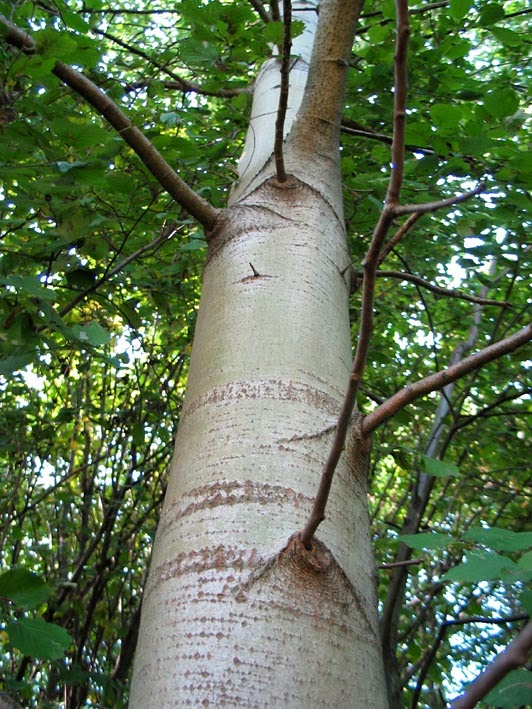
The bark soon becomes rugged, and is almost black at the base, smooth
and grey or brown on the upper part. The branches are all more or less erect.
The tree normally never suckers, but when cut down suckers arise over
practically the whole extent covered by its root system. It is useless for
timber particularly on account of its numerous knots.
The main purpose of
planting the tree is to provide a screen, or a barrier against wind, dust and
noise. It is easily struck from cuttings.
 |
| Populus Nigra - Lombardy Poplar |
 |
| Populus Nigra - Lombardy Poplar |
 |
| Populus Nigra - Lombardy Poplar Bark |
 |
| Lombardy Poplar Woods |
 |
| Populus Nigra - Lombardy Poplar Leaves |
 |
| Populus Nigra - Lombardy Poplar Beauty |
 |
| Populus Nigra - Lombardy Poplar |