Thursday, March 1, 2018

Pinus strobus – Weymouth Pine - White Pine

General Information
Common Name White Pine, Weymouth Pine
Scientific Name Pinus strobus
Sun Tolerance Full Sun
Height 50-58  m (168-188 ft)
Spread 15 - 20 m (50 - 66 ft)
Growth Rate Fast
Bloom Time Spring
Color Green,
Flower Color Green
Type Tree
Native USA, Asia, Europe.
Classification
Kingdom Plantae – Plants
Subkingdom Tracheobionta – Vascular plants
SuperdivisionSpermatophyta – Seed plants
Division Coniferophyta – Conifers
Class Pinopsida
Subclass 
Order Pinales
Family Pinaceae – Pine family
Genus Pinus –  Pine
Species P. strobus


Pinus strobus –  White Pine
Pinus strobus commonly known as Weymouth Pine also known as Eastern White Pine. It’s a vive-needled conifer of the eastern half of North America, now found sparsely throughout Europe, and was introduced in the eighteenth century by Lord Weymouth on his Longleat estate near Bath. It is reputed to have been first grown at Badminton, Gloucestershire, by the Duchess of Beaufort in 1705. It was the first conifer planted in the Forest of Dean. Fine needles and banana-shaped cones make this an interesting tree, but one which is frequently ruined by a rust fungus and by bark aphids.
P. strobus is one of the long living tree. Mature trees are living 200-250 years, sometimes it can lives more than 400 years. It grows approximately 1 M (3.3 ft) yearly between the ages of 15 to 45 years. It is the tallest tree in Easter North America. It grows 50-58 M (168-188 ft) in height. Sometimes it grows up to 70 m (230 ft) tall.
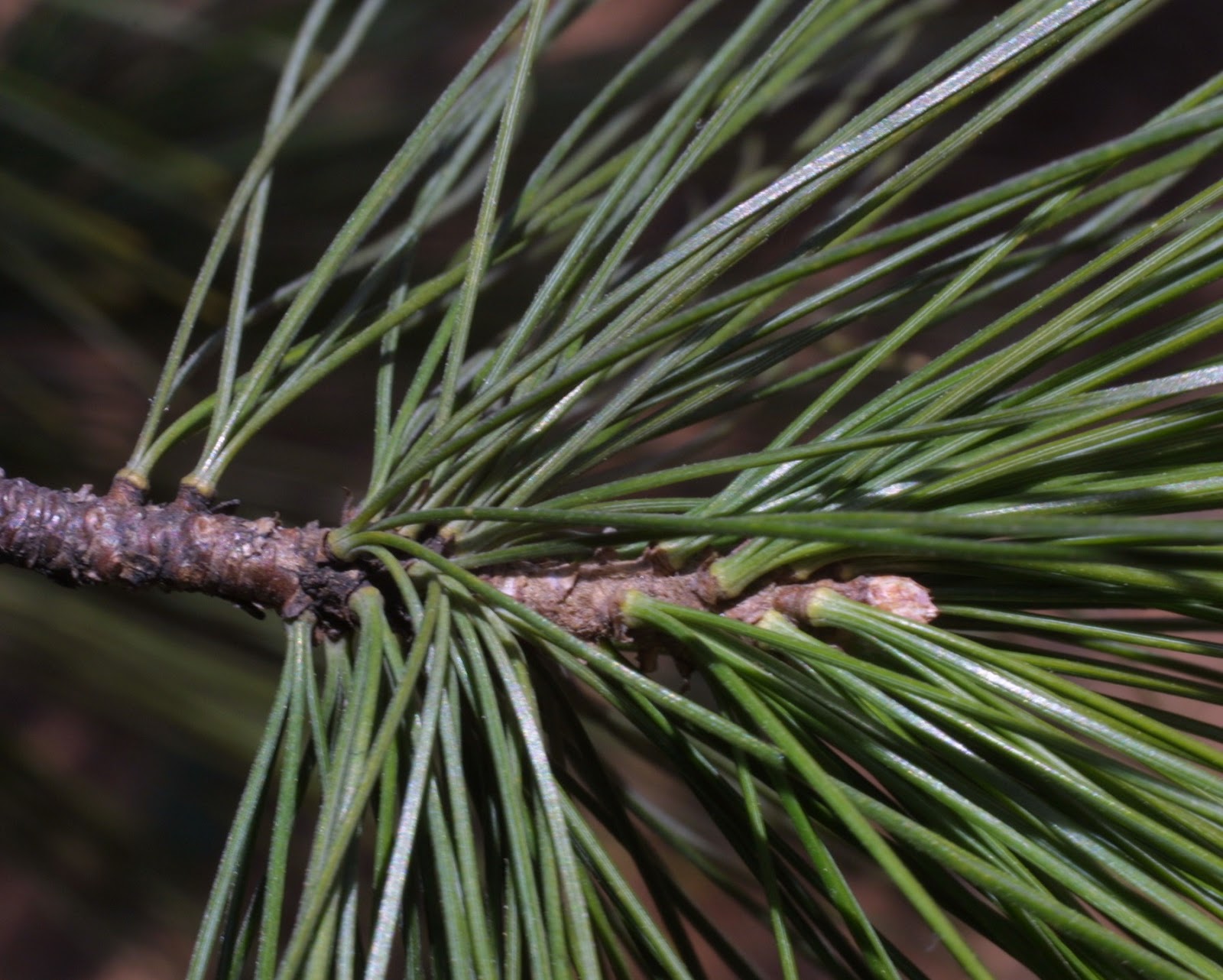
The young shoots are slender and green, later turning greenish-brown becoming roughened by the scars left by fallen needles, but much smoother than two-needle pines. The small resin-coated buds are sharply pointed and greyish-brown. The five pendent needles are thin, 7-13 cm long, blue-green or bluish-grey, and bound together at their base by a sheath consisting of membranous scales.
The flowers of both sexes are found on the same tree. The male catkins are about 1 cm long and are in small clusters, yellow when ripe. The slender female flowers are about 2 cm long, pink with purple scale margins. When young the cones are green, later becoming brown. They are pendent, slightly curved (banana-shaped), up to 15 cm long, their widely separated scales sometimes coated with white blobs of resin. Heavy crops of cones only occur at intervals of from four to seven years.
The bark on young stems is smooth and green or greenish-brown, later becoming dark grey, rough, and deeply fissured into broad, scaly ridges on the lower part of the trunk. The wood is pale brown, light, soft, and fine textured, suitable for joinery and general purposes.
The tree would undoubtedly be a fine timber-producer in southern America and Europe but for the attack of a rust fungus, Cronartium fibicola, which causes ‘blisters’ on the pine shoots and at another stage attacks black-currants and gooseberries. As it is, the tree is now rarely planted.


Pinus strobus –  White Pine

Pinus strobus –  White Pine Leaves

Pinus strobus Leaves

Leaves of  White Pine

Leaves of Pinus strobus 

White Pine Leaves

Male Catkin of White Pine

Male Flowers of White Pine

Pinus strobus male flowers

Female Cone of  White Pine

White Pine Female Cone when rip

The Bark of White Pine

White Pine as Ornamental Plant

Pinus strobus –  White Pine in Park

Ornamental White Pine

Pinus strobus ornamental Plant

Pinus strobus –  White Pine as Christmas Tree

Pinus strobus –  White Pine

Pinus strobus –  White Pine forest

Pinus strobus –  White Pine

Pinus strobus –  White Pine

Pinus strobus –  White Pine

Pinus strobus –  White Pine
Pinus strobus Video: 


Thursday, February 1, 2018

Pinus radiata – Monterey Pine

General Information
Common Name Monterey Pine, Radiata Pine
Scientific Name Pinus radiata
Sun Tolerance Full Sun
Height 15-30  m (50-100 ft)
Spread 6 - 12 m (20 - 40 ft)
Growth Rate Fast
Bloom Time Spring
Color Green,
Flower Color Gold
Type Tree
Native USA, Asia, Europe.
Classification
Kingdom Plantae – Plants
Subkingdom Tracheobionta – Vascular plants
SuperdivisionSpermatophyta – Seed plants
Division Coniferophyta – Conifers
Class Pinopsida
Subclass 
Order Pinales
Family Pinaceae – Pine family
Genus Pinus –  Pine
Species P. radiata

Pinus radiata – Monterey Pine
Pinus radiate commonly known as Monterey Pine also known as Radita Pine or Insignis Pine. It’s a three-needled conifer with striking bright-green luxuriant foliage. It is a native of a very limited area of wet winters and hot dry summers, the Monterey Peninsula of southern California.
P. radiate is a coniferous evergreen tree growing to 15 – 30 m (50 – 100 ft) in height, but some time grows up to 60 m (200 ft).
The young shoots soon become green. The winter buds are light brown, up to 2 cm long, sharply pointed and resinous. The bright emerald green needles are slender, 10-15 cm long, somewhat curved, usually in threes, but occasionally in pairs. They are bound together at their base by a sheath consisting of membranous scales.
The flowers of both sexes are found on the same tree. The male catkins are small, and yellow in late March. The female flowers may be solitary or in small clusters. The cones are asymmetrical, being flattened 7-13 cm long, glossy, woody and greyish-brown. They are often in clusters of three to five and persist on the trees for an indefinite time, usually not opening for several years.
The bark of mature trees is dark brown, thick, and deeply fissured, peeling off in broad scales. The coarse timber is inferior, is used in house construction as weatherboards, posts, beams or plywood, in fencing, retaining walls, for concrete formers. It is also used to a limited extent in boat building where untreated ply is sometimes used, but must be encased in epoxy resin to exclude moisture, boxes and paper pulp.
This pine has no commercial future anywhere in Britain but in South Africa, Australia, New Zealand and Spain it is cultivated on an extensive scale, making phenomenally fast growth. 


Pinus radiata – Monterey Pine as Ornamental Plant

Pinus radiata – Monterey Pine

Young Plants of Monterey Pine

Pinus radiata Young Plant

Leaves of Monterey Pine

Male Catkins of Monterey Pine

Female Cone of Monterey Pine

Pinus radiata Male Catkins and Female Cones

Pinus radiata Female Cone

Female Cones of Monterey Pine

The Bark of Monterey Pine


Pinus radiata – Monterey Pine

Pinus radiata – Monterey Pine Forest

Pinus radiata – Monterey Pine

Pinus radiata – Monterey Pine

Pinus radiata – Monterey Pine
Video of Monterey Pine: