Tuesday, September 10, 2013

Aloe Arborescens - Candelabra Aloe

General Information
Common Name Candelabra Aloe, Krantz Aloe
Scientific Name Aloe arborescens
Sun Tolerance Full Sun
Height 2 – 3 m (6 - 8 ft)
Spread 1.2 – 1.8 m (4 - 6 ft
Growth Rate Slow
Bloom Time Spring
Color Green
Flower Color Red-Orange, Yellow
Type Cactus & Succulents
Native Africa
Classification
Kingdom Plantae – Plants
Subkingdom Tracheobionta – Vascular plants
Superdivision Spermatophyta – Seed plants
Division Magnoliophyta – Flowering plants
Class Liliopsida – Monocotyledons
Subclass Liliidae
Order Liliales
Family Aloaceae – Aloe family
Genus Aloe L. – aloe
Species A. arborescens

Aloe Arborescens - Candelabra Aloe
Aloe arborescens commonly known as Candelabra Aloe also called Krantz Aloe the Afrikaans word "krantz", which means a rocky cliff. It is native to southern of Africa. Aloe arborescens is well known as Aloe Vera. It is usually found in mountainous areas where it favors exposed ridges and rocky outcrops. It is also found in dense bush. This is an evergreen slow growing plant. Aloe arborescens is a large multi-headed sprawling succulent, its specific name indicating that it sometimes reaches tree size that grows to 2 – 3 m (6 – 8 feet). Its leaves are succulent and are green with a slight blue tint. Its leaves are armed with small spikes along its edges and are arranged in rosettes situated at the end of branches. It blooms in spring. The flowers color is red, orange or yellow with cylindrical shape. All plant of this species is also relatively popular among gardeners and has recently been studied for possible medical uses. People cultivate it for aloe jells. Decoctions of the leaves are also used in childbirth and in treating sick calves. In the Transkei it is used for stomach ache and given to chickens to prevent them from getting sick.


Aloe Arborescens - Candelabra Aloe

Aloe Arborescens - Candelabra Aloe

Aloe Arborescens - Candelabra Aloe

Aloe Arborescens - Candelabra Aloe : Flowers Red

Aloe Arborescens - Candelabra Aloe : Flowers Orange

Aloe Arborescens - Candelabra Aloe : Flowers Orange

Aloe Arborescens - Candelabra Aloe

Aloe Arborescens - Candelabra Aloe

Aloe Arborescens - Candelabra Aloe

Aloe Arborescens - Candelabra Aloe

Aloe Arborescens - Candelabra Aloe

Aloe Arborescens - Candelabra Aloe

Aloe Arborescens - Candelabra Aloe

Aloe Arborescens - Candelabra Aloe

Aloe Arborescens - Candelabra Aloe

Thursday, September 5, 2013

Ilex aquifolium – Holly


General Information
Common Name Holly
Scientific Name Ilex aquifolium
Sun Tolerance Full Sun
Height  10–15 m (33–50 ft)
Spread 4.5-6 m (15-20 ft)
Growth Rate Slow
Bloom Time Summer
Color Green
Flower Color White
Type Tree
Native Europe, western Asia, North-west Africa
Classification
Kingdom Plantae – Plants
Subkingdom Tracheobionta – Vascular plants
Superdivision Spermatophyta – Seed plants
Division Magnoliophyta – Flowering plants
Class Magnoliopsida – Dicotyledons
Subclass Rosidae
Order Celastrales
Family Aquifoliaceae – Holly family
Genus Ilex L. – holly
Species I. aquifolium

Ilex aquifolium – Holly
Ilex aquifolium commonly known as Holly Tree. It is probable best known tree – since ancient times it has been connected with pre-Christianfestival and Christmas decoration. However, it is only locally common, mainly in hedgerows or scattered throughout older traditional forests. It is one of the smaller trees, although some specimens attain a height of 50 feet or even more. It will tolerate shade. It can live 500 years, but usually does not reach 100.
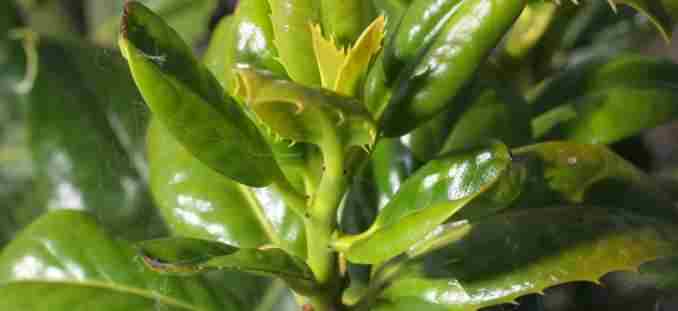
The twigs are stout, bright green or purplish, and slightly angled. The small winter buds are green and sharply pointed. The ovate leaves are dark green above and pale green below, with a waxy or varnished surface, and have a tough, leathery texture. Usually each leaf on the lower branches has a series of sharp points along its margin, higher up, each leaf has but a single point, right at the tip.
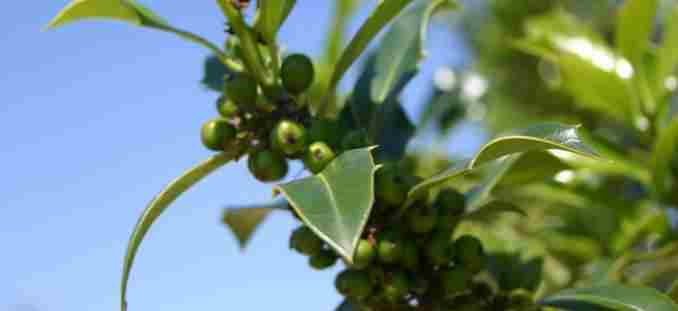
Very occasionally both sexes of flowers are found on one tree. Those trees with only male flowers, of course never berry. The small sweetly scented flowers of May and June are waxy white, lie in clusters in the leaf axils, and have all their parts in fours. The male has four stamens and no pistil. The female has four-lobed ovary surmounted by  a four-parted style and stigma, and rudimentary anthers. The well known decorative berries, green at first and later crimson, contain three or more hard black seeds. 
The bark is smooth and grey to greenish-grey. Over its surface a darker network soon develops and the bark gets somewhat rough and gnarled. The wood is ivory-white and of a fine even texture, hard and heavy. It is well suited to turnery, inlaid work and carving. The tree is a useful hedge plant, since it is evergreen and stands clipping well.
The many decorative garden kinds of holly include trees with variegated leaves, smooth leaves only and yellow berries. The yellow-berried form is sometimes found growing wild. 


Ilex aquifolium – Holly

Ilex aquifolium – Holly

Ilex aquifolium – Holly : Leaves

Ilex aquifolium – Holly : Leaves

Ilex aquifolium – Holly

Ilex aquifolium – Holly : Flowers

Ilex aquifolium – Holly : Flowers & Fruits

Ilex aquifolium – Holly :  Fruits

Ilex aquifolium – Holly :  Fruits

Ilex aquifolium – Holly :  Fruits

Ilex aquifolium – Holly :  Flowers

Ilex aquifolium – Holly :  Fruits

Ilex aquifolium – Holly :  Fruits