Showing posts with label Fruit Tree. Show all posts

Tuesday, April 25, 2023

Cocos nucifera - Coconut Tree

General Information
Common Name 
Coconut Tree
Scientific Name 
Cocos nucifera
Sun Tolerance 
Height 
up to 30 m (up to 100 ft)
Spread 
up to 6 m (up to 20 ft)
Growth Rate 
Fast
Bloom Time 
Round the Year
Color 
Flower Color 
Type 
Native 
Classification
Kingdom 
Plantae – Plants
Subkingdom 
Tracheobionta – Vascular plants
Superdivision
Spermatophyta – Seed plants
Division 
Magnoliophyta – Flowering plants
Class 
Liliopsida - Monocotyledons
Subclass 
Arecidae
Order 
Arecales
Family 
Arecaceae Bercht - Palm family
Genus 
Cocos  L. –  Coconut Palm
Species 
C. nucifera


Cocos nucifera - Coconut Tree
Cocos nucifera, commonly known as Coconut Tree, is a ubiquitous sight in tropical regions around the world. These tall, slender trees can reach up to 30 meters in height and are a valuable resource for people living in these areas. From the roots to the leaves, every part of the coconut tree has a purpose. Let's take a closer look at this amazing tree.
The coconut tree, also known as Cocos nucifera, is a member of the palm family. It is native to the tropics and subtropics of Asia, Australia, and the Pacific region but has been introduced to many other parts of the world. The tree has a single trunk that is usually straight and slender, with a crown of large, feathery leaves at the top.
One of the most important products of the coconut tree is the coconut itself. The coconut is a large, fibrous fruit with a hard, woody shell. Inside the shell is a sweet, nutty-tasting water and a white, meaty flesh that is high in healthy fats and nutrients. Coconuts are used in many different ways, from cooking and baking to making coconut milk, oil, and butter.


In addition to the fruit, the coconut tree also produces a number of other useful products. The leaves of the tree can be woven into baskets, hats, and mats. The trunk of the tree can be used to make furniture, while the bark can be used to make rope and twine. The roots of the tree are also used for medicinal purposes in some cultures.
Perhaps one of the most iconic uses of the coconut tree is for building. The wood from the tree is lightweight, durable, and resistant to insects and decay, making it ideal for construction in tropical areas. Traditional homes, as well as hotels and resorts, are often built from the wood of the coconut tree.
Beyond its practical uses, the coconut tree also plays an important cultural role in many tropical regions. It is a symbol of tropical paradise, and images of swaying coconut trees against a backdrop of blue sky and turquoise water are common in advertising and marketing materials for tropical destinations. In some cultures, the coconut tree is also considered sacred and is used in religious rituals.
Despite its many benefits, the coconut tree faces some challenges. Climate change, for example, is affecting the growth and productivity of coconut trees in some areas. In addition, the demand for coconut products has led to some unsustainable practices, such as clear-cutting forests to plant coconut trees.
Overall, the coconut tree is a remarkable plant that provides numerous benefits to people and the environment. Its versatility and importance to tropical cultures make it a valuable resource that should be respected and protected for generations to come.


Cocos nucifera - Coconut Tree

Coconuts

Coconut young plants

Coconut Tree flowers

Coconut Tree

Coconut Tree Bark

Coconut Tree

Coconut Tree

Coconut Tree leaves

Coconut Tree Leaves

Coconut Tree

Coconut Tree


Wednesday, October 10, 2018

Fuchsia excorticata – Tree Fuchsia

General Information
Common Name Tree Fuchsia
Scientific Name Fuchsia excorticata
Sun Tolerance Full Sun
Height up to 15 m (up to 50 ft)
Spread 3 - 5 m (10 - 16 ft)
Growth Rate Medium
Bloom Time Winter
Color Green,
Flower Color VioletPink 
Type Tree
NativeNew Zealand
Classification
Kingdom Plantae – Plants
Subkingdom Tracheobionta – Vascular plants
Superdivision Spermatophyta – Seed plants
Division Magnoliophyta – Flowering plants
Class Magnoliopsida - Dicotyledons
Subclass Rosidae
Order Myrtales
Family Onagraceae - Evening Primrose Family
GenusFuchsia L. – Fuchsia
Species F. excofticata

Fuchsia excorticata – Tree Fuchsia
Fuchsia excorticata, commonly known as Tree Fuchsia also known as New Zealand Fuchsia is native to New Zealand. It is commonly found throughout New Zealand and as far south as the Auckland Islands.
F. excorticata is the largest member of the genus Fuchsia. It is growing up to 15 m (50 ft) in height and trunk diameter up to 1 m (3.3 ft). It is distinguishable by an unusually light brown or orange bark, which is highly thin and paper like, peeling in strips. It is unusual among New Zealand trees being deciduous in the southern part of its range, losing its leaves in winter in all but the warmest areas.
The leaves of this species include slim petioles, the join being nearly 1 – 4 cm (0.4 – 1.8 in) long. The leaves tend to be approximately 10 mm and ranging from 1.5 – 3 (0.5 – 1.4 in) wind, tend to form an oblong shape with a rounded base. Leaves have a smooth epidermis with the anomaly on the margin and veins. Its margin is serrated with small teeth, color of above generally being dark green and the bellow being paler and more silver.
The attractive, small flowers appear between August and December. They gradually change from greenish-yellow to purple-red. Flowers are solitary and pendulous with an average of 3-4 petals that extend to a point. The flower base generally redder in color before extending into rich petals. The Petals of the flowers are 2 – 5 mm long. The flowers are rich in nectar and are visited by honey-eating birds, especially tui, bellbirds and silvereyes.
The berries range to nearly 10 mm long, ellipsoid-oblong shaped, color is dark purple to almost black. The berry is sweet, juicy and delicious to eat.  It is one of the possum’s preferred food sources. Maori named the berry Konini and on the West Coast of the South Island the plant is known by this name. It makes a sweet tasty jam.  It was also eaten by European settlers in jams and puddings. It also plant as ornamental flowering plant.

Video About Fuchsia excorticata


Fuchsia excorticata – Tree Fuchsia

Leaves of Tree Fuchsia

Fuchsia excorticata Leaves

Tree Fuchsia Leaves

Flowers of Tree Fuchsia

Fuchsia excorticata Flowers

Tree Fuchsia Flowers

Fuchsia excorticata – Tree Fuchsia

Fuchsia excorticata – Tree Fuchsia

Fruits of Tree Fuchsia

Fuchsia excorticata Fruits

Tree Fuchsia Fruits

Bark of Tree Fuchsia

Logs of Tree Fuchsia

Fuchsia excorticata Logs

Fuchsia excorticata – Tree Fuchsia

Fuchsia excorticata – Tree Fuchsia

Fuchsia excorticata – Tree Fuchsia

Fuchsia excorticata – Tree Fuchsia

Fuchsia excorticata – Tree Fuchsia

Fuchsia excorticata – Tree Fuchsia

Fuchsia excorticata – Tree Fuchsia

Fuchsia excorticata – Tree Fuchsia

Fuchsia excorticata – Tree Fuchsia

Friday, September 5, 2014

Vitis vulpina - Frost Grape - Fox Grape

General Information
Common Name Fox Grape, Frost Grape
Scientific Name Vitis vulpina
Sun Tolerance Full Sun
Height Over 12 m (Over 40 ft)
Spread Over 3 m (Over 10 ft)
Growth Rate Fast
Bloom Time Summer
Color Green
Flower Color Yellow
Type Creepers & Climbers
Native United StatesEuropeAsia
Classification
Kingdom Plantae – Plants
Subkingdom Tracheobionta – Vascular plants
SuperdivisionSpermatophyta – Seed plants
Division Magnoliophyta – Flowering plants
Class Magnoliopsida – Dicotyledons
Subclass Rosidae
Order Rhamnales
Family Vitaceae – Grape family
Genus Vitis L. – Grape
Species V. vulpina

Vitis vulpina - Fox Grape
Vitis vulpina common name is Frost Grape also known as Fox Grape is an herbaceous perennial vine. It is native to USA. The genus name Vitis comes from the Latin word for "vine" and the species name vulpina comes from the Latin word for "fox-like" or belonging to a fox. It is believed that foxes were attracted to this type of grapevine and Linnaeus used the term vulpina to differentiate these smaller wild grapes from the other American known grapes. Its acidic/tart-tasting grape becomes more desirable and sweet once it is exposed to a frost. The frost grape is found in much of the eastern half of the United States from New York to Minnesota. V. vulpina has a relatively long lifespan with a moderate growth rate. It is generally a high-climbing woody vine with a thick trunk and red tendrils. Typically the vine will reach a maximum height of about 83 feet.
V. vulpina can be either semi-deciduous or deciduous. It blooms yellow flowers in May to June. The flowers are arranged in compound panicles with 5 yellow petals, 5 sepals and 5 stamen. The leaves are arranged alternately with a cordate shape. Venation is palmate. Unlike other wild grapes there are no tufts of hair present on the leaves. Tendrils appear every third leaf oppositely are reddish in color and used for growth along surfaces. The grapes are tiny and dark purple. It is commonly used for made refreshing drinks. The grapes and the vine itself have many uses ranging from herbal remedies to edible delicacies. Many parts of the plant are used in herbal medicines. The leaves of the plant are used sometimes for liver treatments because they are considered hepatic. When the leaves are wilted, they are used as a poultice to relieve tenderness of the breasts after childbirth. The bark can be infused to treat urinary problems. 
Vitis vulpina - Fox Grape Flowers

Vitis vulpina - Fox Grape Leaf

Vitis vulpina - Fox Grape Leaves

Vitis vulpina - Fox Grape Fruits

Vitis vulpina - Fox Grape Fruits

Vitis vulpina - Fox Grape Fruits

Vitis vulpina - Fox Grape Branch

Wednesday, July 30, 2014

Vitis coignetiae - Crimson Glory Vine

General Information
Common Name Crimson Glory Vine
Scientific Name Vitis coignetiae
Sun Tolerance Full Sun
Height Over 12 m (Over 40 ft)
Spread Over 3 m (Over 10 ft)
Growth Rate Fast
Bloom Time Summer
Color Green, Red
Flower Color Green
Type Creepers & Climbers
Native United StatesEurope, Asia
Classification
Kingdom Plantae – Plants
Subkingdom Tracheobionta – Vascular plants
SuperdivisionSpermatophyta – Seed plants
Division Magnoliophyta – Flowering plants
Class Magnoliopsida – Dicotyledons
Subclass Rosidae
Order Rhamnales
Family Vitaceae – Grape family
Genus Vitis L. – Grape
Species V. coignetiae

Vitis coignetiae - Crimson Glory Vine
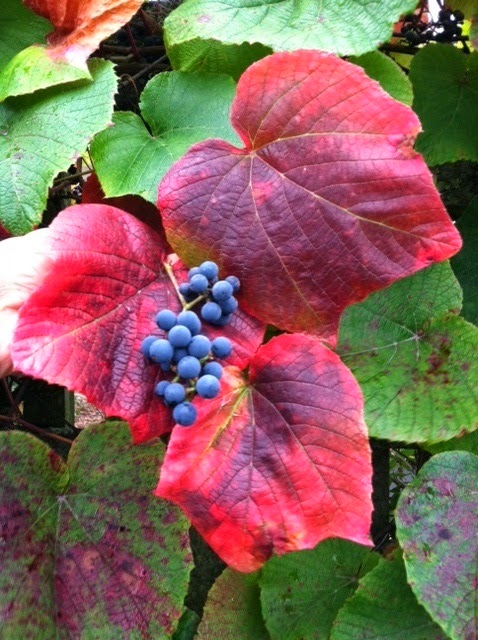
Vitis coignetiae common name is Crimson Glory Vine also known as Grape Vine. It is native to East Asia. It is woody deciduous climber plant.  Crimson Glory Vine length is more then 12 m (50 ft) and spread more than 3 m (10 ft). In the cooler Norman climate the vine produces a bitter wine, rich in color and extract. The vine is very vigorous, with purple shoots. The deciduous leaves are large (15 - 30 cm in diameter), simple, orbicular, toothed, with deep petiole, heart-shaped, shallowly lobed.  The leaves are first in green color then they turn red-orange in autumn. It is full sun plant but also can be grow in semi-shade under the large trees. It blooms green flowers in summer. The fruits are black in color when ripe. 
Wild vines can be male, female or hermaphrodite. Clusters are large with small berries and large purple seeds. It is found in the mountainous regions of Japan and up to 1300 m altitude in Korea. In East Asia it is grown as an ornamental plant for its crimson autumn foliage; and as an Oriental medicinal plant. It is used to produce refreshing drink in Korea and Japan. These are at first bitter, but softened with the addition of sugar. This is very attractive plant, so people like it as ornamental plant


Crimson Glory Vine Leaves

Crimson Glory Vine Red Leaves

Grape Red Leaves

Crimson Glory Vine Flowers

Crimson Glory Vine Green Fruits 

Crimson Glory Vine Ripe Fruites

Crimson Glory Vine Attractive Leaves

Crimson Glory Vine Leaves Red

Crimson Glory Vine

Crimson Glory Vine Red Leaves

Crimson Glory Vine Leaves

Crimson Glory Vine Ornamental

Crimson Glory Vine Nice Leaves

Crimson Glory Vine

Crimson Glory Vine