Showing posts with label Color - Yellow. Show all posts

Friday, August 7, 2015

Ulmus procera – English Elm

General Information
Common Name 
English Elm
Scientific Name 
Ulmus procera
Sun Tolerance 
Height 
up to 40 m (up to 130 ft)
Spread 
12-15 m (38-48 ft)
Growth Rate 
Bloom Time 
Spring
Color 
Flower Color 
Type 
Native 
Asia,  Europe, USA
Classification
Kingdom 
Plantae – Plants
Subkingdom 
Tracheobionta – Vascular plants
Superdivision
Spermatophyta – Seed plants
Division 
Magnoliophyta - Flowering Plants
Class 
Magnoliopsida - Dicotyledons
Subclass 
Hamamelididae
Order 
Urticales
Family 
Ulmaceae – Elm family
Genus 
Ulmus L. – Elm 
Species 
U. procera

Ulmus procera – English Elm
Ulmus procera is commonly known as English Elm is native to Europe and North America. It is a large, deciduous tree.  It is a tree mainly found in Britain, holds a traditional place in lowland landscape because of its adaptability to life in hedgerows –due to its ability to spring up as sucker shoots from the roots of established trees. Unfortunately in recent years the Dutch Elm Disease has greatly reduced the numbers of this fine tree.
The young shoots branch from the stem at an angle of about 60­­0 whereas IN Wych Elm they are about 900. The long shoots have a zigzag growth, and some are irregularly ridged with a corky substance – they are then called ‘subeose’. The small winter buds are of a darker brown than the twigs; they are oval, end in a blunt point, and show several scales. The leaves are oval, with a much toothed margin and a short point; at the base they are oblique or uneven (asymmetrical), and the upper surface is roughened by short hairs. Patches of the foliage turn golden yellow in late summer, but the autumn leaves are among the latest of deciduous trees to fall.
The clusters of bi-sexual precocious flowers are purplish-crimson, and in mass give a reddish tinge to the whole crown when they appear during February or early March clustered close on the leafless twigs. The fruit, a seed (samara) is also formed before the leaves, and lies in the center of a pale green oval wing which is transparent, and notched at the apex. The wings cling festooned in masses of dense green cluster until June when they turn brown and then fall. Fertile seeds are rarely produced in spite of the numerous fruits that develop. English Elm is therefore usually established by rooted suckers.

In outline the tree is usually tall, with two, three or four tiers of crown, and very rarely forked. The grey bark, smooth at first, becomes thick and furrowed into rather narrow ridges or dark grey-blackish squares. The trunk often carries burrs and tufts of epicormics shoots. The heartwood is reddish or dark brown, coarse-textured, strong, firm and heavy, usually with an interlocked grain – hence it is extremely difficult to split and has a tendency to warp. It is long lasting if kept either continuously dry or continuously wet. Among its uses are coffin boards, chairs, tables, cabinets, stools, underwater goods, and furniture for house and garden.


Ulmus procera – English Elm in Autumn

Leaves of English Elm

Leaves of Ulmus procera 

 English Elm Leaves in Autumn

Ulmus procera – English Elm Leaves

Flowers of English Elm

Flowers of Ulmus procera 

Ulmus procera – English Elm Flowers

Seeds of English Elm

Seeds of Ulmus procera

Ulmus procera – English Elm Seeds

Trunks of English Elm

English Elm as Ornamental Plant

English Elm as Ornamental Plant in Autumn

 English Elm in Autumn

Ulmus procera in Autumn

Ulmus procera – English Elm
Elm: 

Wednesday, June 25, 2014

Vitis amurensis - Amur grape

General Information
Common Name Amur Grape
Scientific Name Vitis amurensis
Sun Tolerance Full Sun
Height 20 - 25 m (66 - 82 ft)
Spread 15 -18 m (50 - 60 ft)
Growth Rate Fast
Bloom Time Spring
Color Green, Yellow
Flower Color Green
Type Creepers & Climbers
Native United StatesEurope, Asia
Classification
Kingdom Plantae – Plants
Subkingdom Tracheobionta – Vascular plants
SuperdivisionSpermatophyta – Seed plants
Division Magnoliophyta – Flowering plants
Class Magnoliopsida – Dicotyledons
Subclass Rosidae
Order/ Rhamnales
Family Vitaceae – Grape family
Genus Vitis L. – Grape
Species V. amurensis

Vitis amurensis - Amur grape
Vitis amurensis common name is the Amur grape. It is a species of grape native to the Asian continent. It is a green deciduous tree. In fall it becomes yellow color. It grows 20-25 m(66-82 ft) in Tendrils capable of wrapping around things will entwine the branches of neighboring plants or anything else they can use for support and 15-18 m (50-60 ft) typically spread. The bark is dark, scaly and with vertical stripes on old shoots. 
The leaves vary greatly in shape. They can be solid, three-or five-lobed, ovate or rounded, arched at the base. The size ranges from 9 to 25 cm with sharp edges and rounded-triangular serrate teeth. The surface of the leaves are glabrous above, densely covered with short bristles. In autumn the leaves turn bright colors - red, yellow, orange, brown. It blooms greenish-yellow flower in spring.
Fruits of the Amur grape are spherical black or purple, sometimes dark blue berries ranging from very acidic to sweet, with a diameter in the main to 12 mm, with a thick skin. The sugar content in the fruit reaches 22-23%. In their natural habitat they ripen in late September. The flesh is juicy, the berries are usually sour. The clusters can be large, comparable to the number of berries. In exceptional cases, the length of bunches up to 25 cm, and with a weight of 250 grams (usually 20-70 g).
Most of other grapes it is also widely plant for fruits. They can be eaten raw when ripe. The fruits are mainly use for producing refreshing dink. But Amur Grape plant is looking very attractive so people also very much like to plant it in their garden as an ornamental plant. It is most common in the valleys of rivers and streams, in clearings, forest edges, forests, the lower and middle slopes of mountains, where they climb to trees and spread along the ground. Most grapes species are found in much warmer climates. Only the Amur grape can tolerate winter temperatures down to - 45 °C, and the root zone of the soil to -16 °C.


Amur grape Leaves

Leaves of Amur grape

Flowers of Amur grape

Amur grape Fruits

Fruits of Amur grape

Amur grape Young Plant

Amur grape : Yellow Color

Amur grape : Fall Color

Amur grape : As Ornamental Tree

Amur grape in The Garden

Tuesday, June 10, 2014

Quercus velutina - Black Oak

General Information
Common Name Black Oak
Scientific Name Quercus velutina
Sun Tolerance Full Sun
Height 20-42 m (65-140 ft)
Spread 10 -15 m (40 - 50 ft)
Growth Rate Fast
Bloom Time Spring
Color GreenYellow
Flower Color Yellow
Type Tree
Native America
Classification
Kingdom Plantae – Plants
Subkingdom Tracheobionta – Vascular plants
SuperdivisionSpermatophyta – Seed plants
Division Magnoliophyta – Flowering plants
Class Magnoliopsida – Dicotyledons
Subclass Hamamelididae
Order Fagales
Family Fagaceae – Beech family
Genus Quercus L. – Oak
Species Q. velutina

Quercus velutina - Black Oak
Quercus velutina common name is the Eastern Black Oak but mainly known as simply Black Oak. It is an oak in the red oak (Quercus sect. Lobatae). It is native to eastern North America mainly in USA. It is a common tree in the Indiana Dunes and other sandy dual ecosystems along the southern shores of Lake Michigan. It was previously known as yellow oak due to the yellow pigment in its inner bark. It is a deciduous tree.
Q. Velutina grows 20–25 m (65–80 ft) in height and a diameter of 90 cm (35 in), some time it grows up to 42 m (140 ft). Black oak is well known to readily hybridize with other members of the red oak (Quercus sect. Lobatae) group of oaks being one parent in at least a dozen different named hybrids.
The black oak’s leaves are arranged alternately on the twig and are 10–20 cm (4–8 in) long with 5-7 bristle tipped lobes separated by deep U-shaped notches. The upper surface of the leaf is a shiny deep green; the lower is yellowish-brown. There are also satellite hairs on the underside of the leaf that grow in clumps. Black oak is monoecious. The staminate flowers develop from leaf axils of the previous year and the catkins emerge before or at the same time as the current leaves in spring. The pistil-late flowers are borne in the axils of the current year's leaves and may be solitary or occur in two- to many-flowered spikes. 
The fruit, an acorn that occurs singly or in clusters of two to five, is about one-third enclosed in a scaly cup and matures in 2 years. Black oak acorns are brown when mature and ripen from late August to late October, depending on geographic location. In forest stands, black oak begins to produce seeds at about age 20 and reaches optimum production at 40 to 75 years. It is a consistent seed producer with good crops of acorns every 2 to 3 years. In Missouri, the average number of mature acorns per tree was generally higher than for other oaks over a 5-year period, but the number of acorns differed greatly from year to year and from tree to tree within the same stand. The number of seeds that become available for regenerating black oak may be low even in good seed years. Insects, squirrels, deer, turkey, small rodents, and birds consume many acorns. They can eat or damage a high percentage of the acorn crop in most years and essentially all of it in poor seed years. Black oak acorns from a single tree are dispersed over a limited area by squirrels, mice, and gravity. The blue jay may disperse over longer distances.
Quercus velutina - Black Oak Young Plant
The inner bark of the black oak contains a yellow pigment called quercitron, which was sold commercially in Europe.
It is the forest cover type that designates pure stands of the species or those in which it makes up more than 50 percent of the stand basal area. In southern New England, black oak grows on cool, moist soils. Elsewhere it occurs on warm, moist soils. Black oak grows on all aspects and slope positions. It grows best in coves and on middle and lower slopes with northerly and easterly aspects.  Wildfires seriously damage black oak trees by killing the cambium at the base of the trees. This creates an entry point for decay fungi. The end result is loss of volume because of heart rot. Trees up to pole size are easily killed by fire and severe fires may even kill saw timber. Many of the killed trees sprout and form a new stand. However, the economic loss may be large unless at least some of it can be salvaged.


Leaves of Black Oak

Leaves of Black Oak

Flowers of Black Oak

Black Oak Flowers

Black Oak Fruits

Acorn of Black Oak

Bark of Black Oak

Black Oak

Black Oak Buds 

Black Oak

Black Oak

Black Oak

Yellow colored Black Oak

Black Oak in Autumn

Black Oak

Tuesday, February 25, 2014

Populus tremula – Aspen


General Information
Common Name Aspen
Scientific Name Populus tremula
Sun Tolerance Full Sun
Height 10-20 m (33 - 66 ft)
Spread 6 -12 m (20 - 40 ft)
Growth Rate Fast
Bloom Time Early Spring
Color Green
Flower Color Yellow
Type Tree
Native Europe, USA
Classification
Kingdom Plantae – Plants
Subkingdom Tracheobionta – Vascular plants
SuperdivisionSpermatophyta – Seed plants
Division Magnoliophyta – Flowering plants
Class Magnoliopsida – Dicotyledons
Subclass Dilleniidae
Order/ Salicales
Family Salicaceae – Willow family
Genus Populus L. – cottonwood
Species P. tremula

Populus tremula – Aspen
Populus tremula common name is Aspen also called European Aspen. This is a moderate sized poplar, erect with a lender crown and trunk, is perhaps best known from its roundest leaves which almost ceaselessly quiver and rustle even on calm days. It is very hardy and tolerates well places, unfortunately perhaps, it is often surrounded with numerous suckers which may even form a thicket.
The adult leaves, produced on branches of mature trees, are nearly round, slightly wider than long, 2–8 cm diameter, with a coarsely toothed margin and a laterally flattened petiole 4–8 cm long. The young green shoots soon become smooth and golden brown, and then darken. The branch-less are smooth and shiny with winter buds that are shiny reddish-brown and sometimes somewhat sticky. The roundish leaves, on a long thin much flattened leaf-stalk, are dull, rich green on top, paler yellow underneath, three prominent veins radiate from the base, and the outer rim has indented edges and is sometimes tinged with red. The quivering leaves persist on the tree late into the autumn, turning a rich yellow before they fall.
The male catkins, which open late in February, are woolly on account of the deeply cut and hairy scales, they have purple stamens, later contrasting with the yellow pollen. The seed capsules burst in the latter part of May, but seed rarely germinates well. Propagation is best by root cuttings.
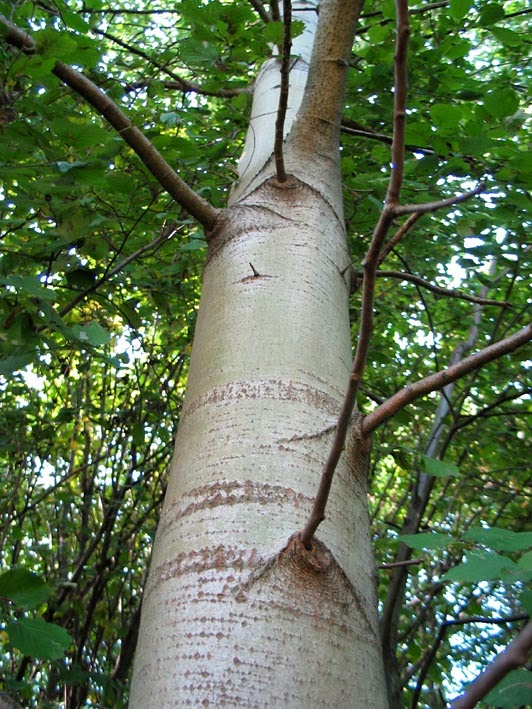
At first the bark is pale greenish-grey and smooth, becoming dark grey and rugged with age. The white wood is light and soft, and is excellent for match sticks and match boxes. Other uses include ‘chip’ baskets, paper pulp and wood wool. The tree seldom reaches a suitable timber size in Europe, so attempts to cultivate it are rare.


Populus tremula – Aspen

European Aspen : Leaves

European Aspen : Leaves

European Aspen : Leaves

European Aspen : Flowers

European Aspen : Flowers

European Aspen : Flowers

European Aspen : Bark

European Aspen : Trunk

European Aspen : Log

European Aspen : in Autumn

European Aspen in Autumn

European Aspen in Autumn

European Aspen

European Aspen