| General Information |
| Common Name | Norway Spruce |
| Scientific Name | Picea abies |
| Sun Tolerance | Full Sun |
| Height | 35 - 55 m (115 - 180 ft) |
| Spread | 10 -15 m (33 - 50 ft) |
| Growth Rate | Fast |
| Bloom Time | Spring |
| Color | Green, |
| Flower Color | Pink |
| Type | Tree |
| Native | USA, Asia, Europe. |
|
|
| Classification |
| Kingdom | Plantae – Plants |
| Subkingdom | Tracheobionta – Vascular plants |
| Superdivision | Spermatophyta – Seed plants |
| Division | Coniferophyta – Conifers |
| Class | Pinopsida |
| Subclass |
|
| Order | Pinales |
| Family | Pinaceae – Pine family |
| Genus | Picea Diert – Spruce |
| Species | P. abies |
|
|
 |
| Picea abies - Norway Spruce |
Picea abies commonly known as Norway Spruce, is native to
Europe. It is one of European best known conifers, being her traditional
Christmas Tree. It is introduced from Europe or Scandinavia around 1500, and
increasingly planted all other countries from the seventeenth century. It is a
large and fast-growing evergreen coniferous tree that grows 35–55 m (115–180
ft) in height and with a trunk diameter of 1 - 1.5 m (3-6 ft). It grows fast
when young, up to 1 m (3 ft) per year for the first 25 years under good
conditions, after that becomes slower once over 20 m (66 ft) in height.
Sometimes it grows over 55 m (180 ft). The tallest measured Norway spruce, 62 m
(204 ft) in height, grows near Ribnica na Pohorju, Slovenia.
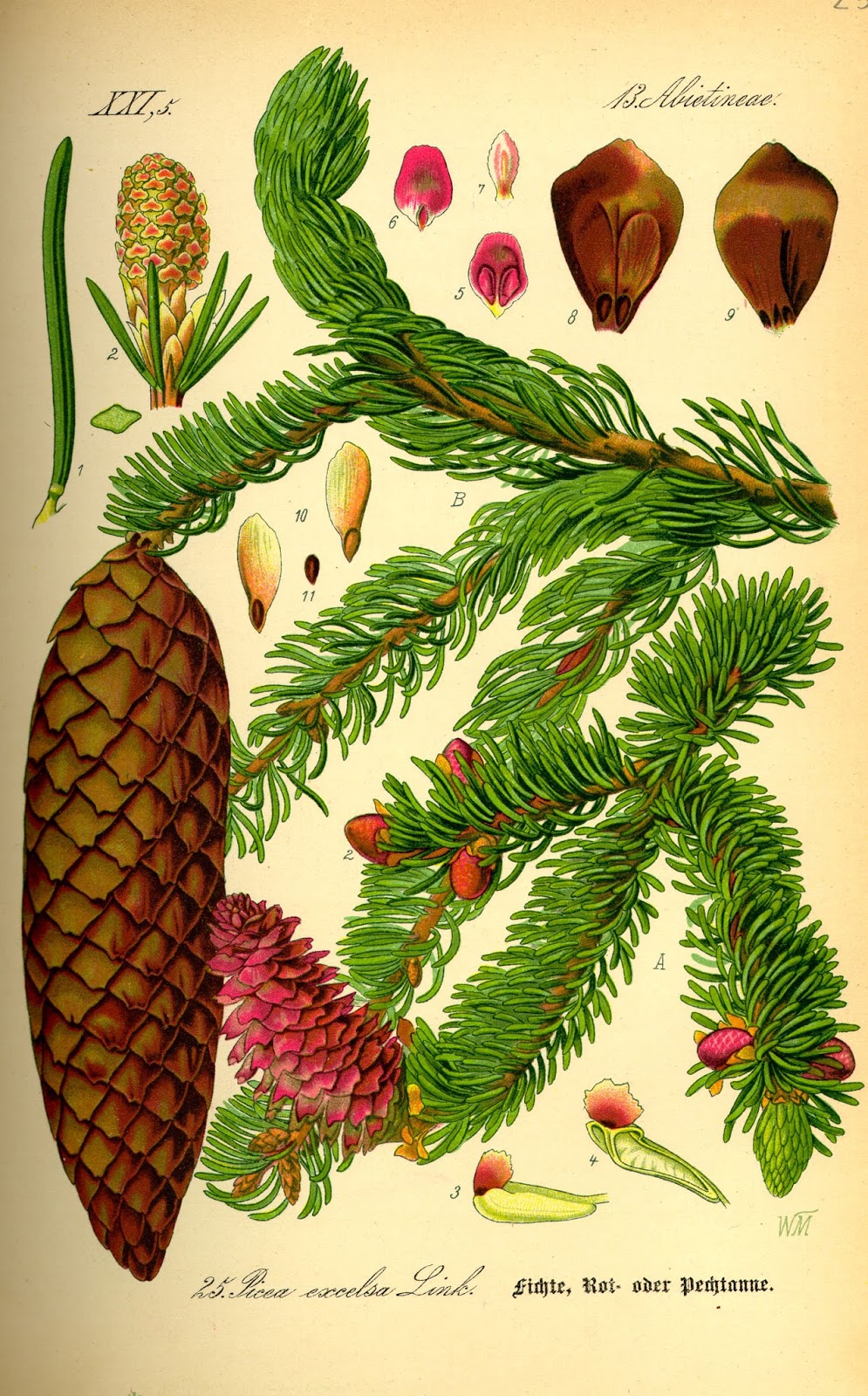
The young shoots are reddish-brown to orange-red. The buds
are yellow-brown smooth, pointed, and free of resin. The needles are light to
dark green, stiff, up to 2.5 cm long, four-sided, and end in a point which is
not harshly sharp. They lie in a shallow plane with distinct upper and lower
sides. Each needle stands on a little peg projecting from the twig and when
pulled away, the peg goes with the needle, accompanied by a short strip of
bark; needles that fall naturally leave their pegs behind. The new pale green
needles which appear in June fringe the edges of all the branches, giving the
tree its best appearance.
The flowers of both sexes are found on the same tree. The
clusters of stalked male catkins are about 2.5 cm long, oval, pendulous or
spreading, red at first but becoming yellow in May. The female flowers usually
higher up the tree; are small oval erect structures, stalk-less and green or
even crimson-colored. After fertilization the conelets change to green or
violet-purple, and gradually turn over until in the autumn they are pendent,
long cylindrical cones, becoming light reddish-brown in the process and 10-15
cm long with compact scales having a texture like tough paper. The cones,
usually towards the top of the tree, fall some considerable time after most of
the winged seeds have been released in mid-autumn.
 |
| Picea abies - Norway Spruce |
The bark is reddish-brown at first, and looks smooth –
though rough to the touch because of small fibrous scales or small
irregularities. Later it becomes greyish-brown with a reddish sheen on the
exposed side and breaks into small, thin, scales; in all but very old trees it
remains thin. The tree is at first conical in shape, later developing a narrow
crown, with short sometimes drooping branches. The base usually broadens and is
often buttressed. The wood is tough and elastic, but has no natural durability
out of doors, and its heartwood is hard to treat with preservatives. White to
pale yellow in color, without color distinction of heartwood and sapwood, it is
much used for box-making, interior joinery and carpentry, paper pulp,
chipboard, pit-props, and general purposes. In the trade it is usually called
‘white wood’.