Showing posts with label Bangladeshi Tree. Show all posts

Tuesday, July 1, 2025

Cycas pectinata – Fern Palm

General Information
Common Name 
Fern Palm
Scientific Name 
Cycas pectinata
Sun Tolerance 
Height 
Up to 10 m (up to 33 ft)
Spread 
3 - 5 m (10 - 17 ft)
Growth Rate 
Bloom Time 
When Matured
Color 
Flower Color 
Type 
Native 
Classification
Kingdom 
Plantae – Plants
Subkingdom 
Tracheobionta – Vascular plants
Superdivision
Spermatophyta – Seed plants
Division 
Cycadophyta - Cycads
Class 
Cycadopsida
Subclass 
Cycadidae
Order 
Cycadales
Family 
Cycadaceae Pers. - Cycad family
Genus 
Cycas L. – Cycad
Species 
C. edentata L.

Cycas pectinata – Fern Palm
Cycas pectinata is a species of cycad, commonly known as Fern Palm. It is a group of ancient seed plants that have existed since the time of the dinosaurs. Often referred to as "living fossils," cycads like Cycas pectinata are prized for their unique appearance, slow growth, and evolutionary significance. Native to parts of South and Southeast Asia, this species is one of the larger and more striking cycads, both in natural habitats and botanical gardens.
The Fern Palm, is a medium to large-sized cycad. It typically grows as a solitary trunked plant that may reach up to 10 meters (33 ft) tall in mature specimens. The trunk is cylindrical and covered with persistent leaf bases. Its leaves are pinnate (feather-like), dark green, and can grow up to 3 meters long, giving the plant a palm-like appearance.
The leaflets are narrow and arranged in a distinct comb-like pattern, which gives the species its name — “pectinata” meaning “comb-like.” New leaves often emerge with a bronze or reddish tint, gradually turning green as they mature.
Fern Palm is found in the subtropical and tropical forests of northeastern India, Bhutan, Nepal, Bangladesh, northern Myanmar, northern Thailand, Laos, and parts of southern China. It typically grows on slopes, rocky hillsides, or in open forest areas, often at elevations between 300 and 1,200 meters above sea level.
Like all cycads, Cycas pectinata is dioecious, meaning male and female reproductive organs occur on separate plants. Males produce cone-like structures called microstrobili, while females bear megasporophylls, which are modified leaves bearing ovules. Pollination is usually facilitated by wind or insects. After fertilization, large seeds are produced, which may take several months to mature. Germination is slow, and seedlings grow very gradually, sometimes taking years to develop a recognizable trunk.
Cycads play an important role in forest ecosystems, including nitrogen fixation through symbiotic relationships with cyanobacteria in their roots. In some traditional cultures, cycads are used for ornamental purposes, religious ceremonies, and even food — though seeds must be carefully processed to remove toxins.
Due to its striking appearance and historical significance, Cycas pectinata is cultivated in tropical and subtropical gardens around the world. It prefers well-drained soil, partial shade, and protection from frost. However, care must be taken when growing cycads, as many species contain toxic compounds and should be handled with care, especially around pets and children.
Cycas pectinata is a remarkable species that connects the present-day flora with the prehistoric world. Its majestic form, resilience, and rarity make it a plant of both scientific interest and ornamental value. Preserving this species in its natural habitat and through sustainable cultivation is essential to maintaining the biodiversity of ancient plant lineages. While Fern Palm is not currently classified as endangered, it faces threats from habitat destruction, deforestation, and illegal collection for ornamental and horticultural purposes. In many regions, wild populations are in decline. Conservation efforts include habitat protection, regulation of trade, and propagation in botanical gardens and nurseries.


Cycas pectinata – Fern Palm

Cycas pectinata – Fern Palm Young Plant

Cycas pectinata Young Plant 

Young Plant of Fern Palm

Young Plant of Cycas pectinata – Fern Palm

Cycas pectinata – Fern Palm Leaves

Cycas pectinata Leaves

Leaves of Cycas pectinata
Cycas pectinata – Fern Palm Trunk

Cycas pectinata – Fern Palm Male cone

Fern Palm Male Cone

Cycas pectinata Male Cone

Cycas pectinata Megasporophyll

Megasporophyll of Fern Palm

Fern Palm Megasporophyll

Matured Megasporophyll

Cycas pectinata – Fern Palm Seed

Cycas pectinata – Fern Palm

Cycas pectinata – Fern Palm

Cycas pectinata – Fern Palm


Sunday, April 16, 2023

Calotropis gigantea - Crown Flower

General Information
Common Name 
Crown Flower
Scientific Name 
Calotropis gigantea
Sun Tolerance 
Height 
up to 6 m (up to 20 ft)
Spread 
up to 2 m (up to 6 ft)
Growth Rate 
Bloom Time 
Summer
Color 
Flower Color 
Type 
Native 
Asia, Australia 
Classification
Kingdom 
Plantae – Plants
Subkingdom 
Tracheobionta – Vascular plants
Superdivision
Spermatophyta – Seed plants
Division 
Magnoliophyta – Flowering plants
Class 
Magnoliopsida – Dicotyledons
Subclass 
Asteridae
Order 
Gentianales
Family 
Asclepiadaceae -Milkweed Family
Genus 
Calotropis - Milkweed
Species 
C. gigantea


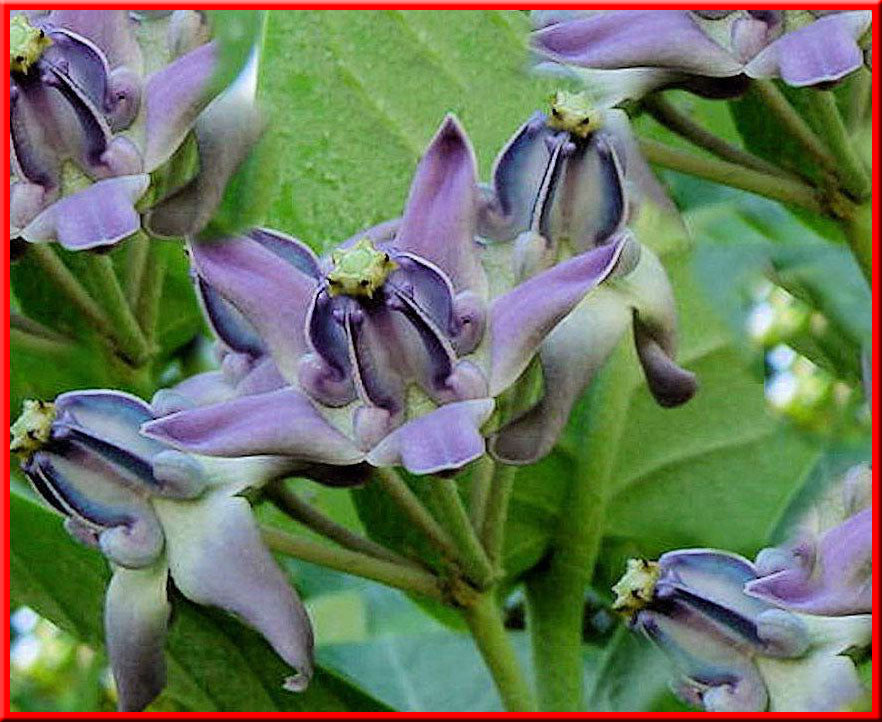
Calotropis gigantea – Crown Flower
Calotropis gigantea, also known as Crown Flower, is a tropical shrub or small tree native to Southeast Asia, India, and Australia. It belongs to the family Apocynaceae and is closely related to other members of the genus Calotropis, including Calotropis procera. It is also called The Giant Milkweed tree.
Calotropis gigantea can grow up to 6 meters tall, with a trunk up to 30 cm in diameter. The leaves are large, up to 30 cm long and 20 cm wide, and are arranged spirally on the stem. The flowers are showy, with a diameter of about 5 cm, and are typically purple or white with a yellow center. The fruit is a large follicle up to 15 cm long and contains many seeds, each with a tuft of silky hairs that aids in wind dispersal.
Calotropis gigantea has been used for various medicinal purposes in traditional medicine. Different parts of the plant, including the leaves, roots, and flowers, have been used to treat a wide range of ailments, such as fever, cough, asthma, and skin diseases. The latex obtained from the plant is used to treat wounds and skin infections. The plant is also used in religious ceremonies in some cultures.


In addition to its medicinal uses, Calotropis gigantea has other practical uses. The fibers in the bark and stem can be used for making rope and paper, and the latex can be used to coagulate rubber. The plant is also used in landscaping and as an ornamental plant in gardens, due to its attractive flowers.
Calotropis gigantea can be grown in tropical and subtropical regions, and is tolerant of drought and poor soil conditions. It is commonly propagated by seed or stem cuttings. The plant requires full sun and moderate watering, and can be pruned to maintain its shape and size.
Despite its beneficial uses, Calotropis gigantea can be toxic to humans and animals if ingested. The sap contains cardenolides, which can cause gastrointestinal distress, heart palpitations, and even death in large doses. The plant can also cause skin irritation in some individuals, particularly those with sensitive skin. Therefore, caution should be exercised when handling the plant.


Calotropis gigantea - Crown Flower

Calotropis gigantea - Crown Flower

Crown Flower Seeds

Crown Flower Seeds

Crown Flower seeds

Crown Flower Leaves

Crown Flower Leaves

Crown Flower

Crown Flower

Crown Flower

Crown Flower


Monday, April 10, 2023

Nymphaea rubra - Red Water Lily

General Information
Common Name 
Red Water Lily
Scientific Name 
Nymphaea rubra
Sun Tolerance 
Height 
up to 2 m (up to 6 ft)
Spread 
up to 1 m (up to 3 ft)
Growth Rate 
Fast
Bloom Time 
Summer
Color 
Flower Color 
Type 
Native 
Classification
Kingdom 
Plantae – Plants
Subkingdom 
Tracheobionta – Vascular plants
Superdivision
Spermatophyta – Seed plants
Division 
Magnoliophyta – Flowering plants
Class 
Magnoliopsida – Dicotyledons
Subclass 
Magnoliidae
Order 
Nymphaeales
Family 
Nymphaeaceae - Lily Family
Genus 
Nymphaea - Lily
Species 
N. rubra


Nymphaea rubra – The Red Water Lily
Nymphaea rubra, commonly known as the Red Water Lily, is a beautiful aquatic plant that belongs to the family Nymphaeaceae. This plant is native to the tropical regions of Asia, particularly in India, Sri Lanka, and Bangladesh. The Red Water Lily is a popular ornamental plant in water gardens and is well-known for its vibrant red flowers that float on the surface of the water.
The Red Water Lily is a perennial plant that grows in shallow water up to a depth of 1.5 meters. The plant has long, oval-shaped leaves that can grow up to 30 centimeters in diameter. The leaves are green with a reddish tint on the underside. The Red Water Lily blooms from May to September, producing beautiful, cup-shaped flowers that can be up to 20 centimeters in diameter. The flowers have deep red petals and a yellow center, which is surrounded by a halo of bright red stamens.
One of the unique features of the Red Water Lily is that its flowers open in the morning and close in the afternoon, lasting for only a day. The plant reproduces through seeds, which are produced in a large, round fruit that is about 8-10 centimeters in diameter. The fruit contains numerous seeds that are dispersed through the water.


The Red Water Lily has a long history of use in traditional medicine. In India, the plant is used to treat various ailments such as fever, dysentery, and inflammation. The roots of the plant are also used in Ayurvedic medicine as a remedy for insomnia and anxiety.
In addition to its medicinal properties, the Red Water Lily is also used for ornamental purposes. The plant is a popular choice for water gardens, adding a pop of color to the water. The Red Water Lily requires full sun to partial shade and nutrient-rich soil. It is a hardy plant that can withstand temperatures ranging from 15-35°C.
The Red Water Lily (Nymphaea rubra) is a beautiful aquatic plant that is known for its vibrant red flowers and long, oval-shaped leaves. The plant has a rich history of use in traditional medicine and is also a popular ornamental plant in water gardens. If you're looking to add a splash of color to your water garden, the Red Water Lily is definitely worth considering.


Nymphaea rubra -  Red Water Lily

Red Water Lily

Red Water Lily

Red Water Lily with leaves

Red Water Lily

Red Water Lily seeds

Red Water Lily

Red Water Lily leaves

Red Water Lily

Red Water Lily


Thursday, April 6, 2023

Nymphaea odorata - White Water Lily

General Information
Common Name 
White Water Lily
Scientific Name 
Nymphaea odorata
Sun Tolerance 
Height 
up to 2 m (up to 6 ft)
Spread 
up to 1 m (up to 3 ft)
Growth Rate 
Bloom Time 
Summer
Color 
Flower Color 
Type 
Native 
Classification
Kingdom 
Plantae – Plants
Subkingdom 
Tracheobionta – Vascular plants
Superdivision
Spermatophyta – Seed plants
Division 
Magnoliophyta – Flowering plants
Class 
Magnoliopsida – Dicotyledons
Subclass 
Magnoliidae
Order 
Nymphaeales
Family 
Nymphaeaceae - Lily Family
Genus 
Nymphaea - Lily
Species 
N. odorata


Nymphaea odorata – White Water Lily
Nymphaea odorata commonly known as White Water Lily is an aquatic plant species that belongs to the family Nymphaeaceae. It is also commonly known as fragrant water lily or American white water lily. This plant is native to North America and can be found in various aquatic environments such as lakes, ponds, and slow-moving rivers.
White water lilies have large, circular, floating leaves that can reach up to 30 cm in diameter. The leaves are green on the upper surface and reddish-purple on the lower surface. The flowers are white and fragrant, with 4-20 petals, and can grow up to 20 cm in diameter. The flowers bloom during the day and close at night. The plant also has long, flexible stems that attach the leaves and flowers to the underwater roots.
White water lilies are found throughout North America, including Canada, the United States, and Mexico. They prefer shallow water bodies, such as ponds, marshes, and lakes, with a moderate amount of sunlight. The plant can grow in water that is up to 3 meters deep.


White water lilies play an important role in their ecosystem. The large leaves provide shade and cover for aquatic animals, while the flowers provide a food source for pollinators such as bees and butterflies. The plant also serves as a habitat for a variety of aquatic animals, including fish, turtles, and frogs.
The white water lily has cultural significance in various indigenous cultures in North America. It is known to symbolize peace, tranquility, and purity in some Native American cultures. The plant has also been used for medicinal purposes by indigenous communities, as well as in traditional herbal medicine.
The white water lily is a beautiful and important aquatic plant species that plays a vital role in its ecosystem and has cultural significance in various indigenous cultures in North America.


Nymphaea odorata - White Water Lily

White Water Lily

White Water Lily

White Water Lily

White Water Lily

White Water Lily Seeds

White Water Lily Seeds Pods

White Water Lily Leaves


White Water Lily

White Water Lily